 Call us: (802) 793-0488
  Available 24/7

If you’ve gotten a quote to remove a tree and thought, “Why does it cost that much?” you’re definitely not the first person to ask.
From the ground, tree removal can look pretty simple. Cut the tree down, clean it up, and move on. But depending on where the tree is and what condition it’s in, there can be a lot more involved.
A big part of tree removal pricing comes down to how safely we can get the tree on the ground without damaging your house, garage, vehicles, power lines, or anything else nearby.
If you’re looking for actual numbers, we also put together a breakdown of how much tree removal costs in Central Vermont, including typical price ranges for different types of jobs.
What Goes Into the Cost of Tree Removal?
No two tree removals are exactly the same. Our tree removal and trimming services range from straightforward removals in open areas to hazardous trees that require climbing, rigging, and careful planning.
A smaller tree in the middle of an open yard may be a fairly easy job. A large maple hanging over a roof is a different story. The same goes for a dead tree next to a road or a pine growing somewhere we can’t easily get equipment to.
A few things we look at when pricing a job include:
- The size of the tree
- How close it is to buildings, power lines, roads, or other obstacles
- Whether the tree is dead, damaged or rotting
- How easily we can get our equipment to it
- Whether the tree needs to be climbed or rigged
- How much cleanup and hauling is involved
Sometimes we can safely drop a tree in an open area. Other times, it has to come down one piece at a time.
Tree Removal in Vermont Has Its Own Challenges
Vermont weather can be hard on trees.
Heavy snow, ice, high winds, and changing temperatures can damage limbs and weaken trees over time. We also deal with plenty of large, mature maples, pines, oaks, and ash trees throughout the area.
The terrain matters too. A tree sitting on a steep hillside or behind a house with limited access may require a completely different approach than the same tree sitting next to an open field.
We see these situations all the time on jobs around Vermont, which is why it’s difficult to price a tree based on its height alone.
Why Not Just Cut It Down From the Bottom?
If there’s plenty of room and the tree is in good condition, sometimes that is exactly what we can do. The problem is that a lot of trees aren’t sitting in wide-open spaces.
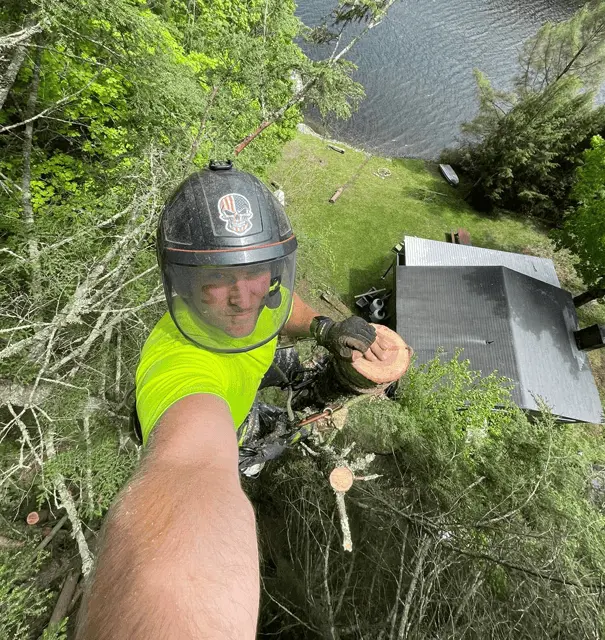
If there’s a house, garage, fence, power line, or other obstacle nearby, we may need to climb the tree and remove it in sections. Ropes and rigging can be used to control where those sections go instead of simply letting them fall.
That takes more time, but it also helps protect your property.
One Way to Avoid a More Expensive Removal
If you already know a tree is declining or you’re worried about it, it’s usually better to have someone look at it sooner rather than later.
If you’re not sure whether the tree actually needs to come down, our guide on tree removal vs. tree trimming goes over some of the signs that can help you tell the difference.
Waiting until a tree is badly damaged or comes down during a storm can turn a planned removal into an emergency job. At that point, there may be fewer options for safely dealing with it.
Frequently Asked Questions
Why can two similar-sized trees cost different amounts to remove?
Size is only one part of the job. A tree next to a house with limited equipment access can take much longer to remove than a similar-sized tree standing in an open yard.
Are dead trees more expensive to remove?
They can be. Dead trees can become brittle or unstable, which may make them more difficult to safely climb or remove.
Does tree removal include the stump?
Not necessarily. Stump grinding may be priced separately, so it’s worth asking what is included in your estimate.
Why does a tree near my house cost more?
There’s usually less room to work. Instead of dropping the tree, it may need to be taken apart in smaller sections to protect the house and surrounding property.
Can I keep the wood after the tree is removed?
In many cases, yes. If you want to keep some of the wood for firewood or another use, bring it up when getting your estimate.
When should I get a tree looked at?
If you notice dead limbs, cracks, leaning, storm damage, rot, or anything else that doesn’t look right, it’s worth having someone take a look before the problem gets worse.
Need a Tree Removed?
If you have a tree you’re worried about, give Snapping Turtle Tree Works a call. We’ll come out, take a look at the tree and the property, and explain what it will take to remove it safely.