Call us: (802) 793-0488
  Available 24/7

Fruit tree trimming throughout Central Vermont with a focus on winter pruning, managing overgrowth and maintaining a better structure for future growth.
Fruit Tree Trimming
Fruit tree trimming throughout Central Vermont with a focus on winter pruning, controlling overgrowth and keeping your trees in better shape for the next growing season.
Fruit Tree Trimming in Central Vermont
Fruit trees need a little different approach.
We're not just cutting off a branch because it's hanging over the driveway. With a fruit tree, we have to think about what we're removing and how the tree is going to respond afterward.
Snapping Turtle Tree Works provides fruit tree trimming throughout Central Vermont, with much of the pruning done during the winter while the trees are dormant. You can also explore our other tree services.
Some people have a couple of apple trees they've kept up with pretty well.
Then there are the ones that haven't been touched in ten years.
Those are usually pretty obvious.
If you're not sure what your fruit trees need, we'll take a look.
Why Trim Fruit Trees During the Winter?
Once the leaves drop, you can actually see the tree.
That's a big part of it.
Branches that cross each other become easier to spot and you get a much better look at how the tree has grown. Areas that have become crowded stand out too.
Many fruit trees are also dormant during the winter, which makes this a common time to get pruning done before spring growth takes off again.
That doesn't mean every fruit tree gets treated exactly the same.
The tree still matters.
So does what we're trying to accomplish with it.
What Should Actually Be Cut?
There should be a reason for every cut.
Sometimes a fruit tree has become so crowded that branches are growing right through the middle of it. You might have dead wood mixed in or branches rubbing against each other.
Other times, there really isn't that much wrong.
Maybe it only needs a little attention.
We're not trying to remove as much wood as possible. In fact, going too far can create more problems than it solves.
Fruit trees can put out a lot of new growth after heavy pruning.
More cutting isn't always better.
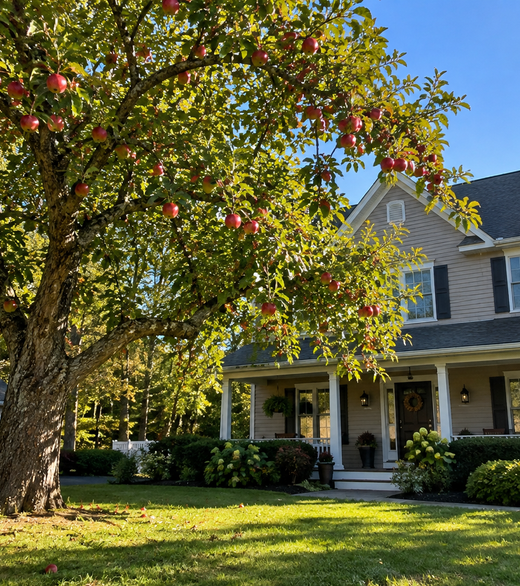
That Old Apple Tree in the Backyard
You know the one.
It's probably been there longer than you have.
Nobody has pruned it in years and now it's much bigger than it used to be. The inside is packed with branches and half the fruit ends up somewhere you can't reach anyway.
Old fruit trees like this aren't unusual around Central Vermont.
They can need quite a bit of work.
That doesn't mean we're going to show up and cut half the tree off in one shot.
If a tree has spent years getting overgrown, getting it back into shape may take some time. Trying to correct everything at once can be too much.
We'll see what we're starting with first.
When the Middle of the Tree Gets Too Crowded
Fruit trees can fill in fast.
New shoots appear between older branches and before long, there's growth going in just about every direction.
That makes the canopy dense.
Pruning can open some of that space back up and allow more light into the tree.
But we're not trying to hollow it out.
The tree still needs enough growth left behind to do what a tree is supposed to do.
It's more about choosing what should stay and what isn't helping.
Dead or Damaged Branches
Vermont winters aren't always kind to trees.
Snow loads branches down and ice can add even more weight. Sometimes a limb cracks but doesn't completely break off.
Those problems are easier to spot once the leaves are gone.
We also look for dead wood and branches that are rubbing against each other. A branch growing directly through the middle of the canopy may be worth addressing too.
Some of this is pretty straightforward.
Other cuts require a little more thought.
That's especially true on a tree that's been growing unchecked for a long time.
My Fruit Tree Is Huge. Can You Make It Smaller?
Maybe.
This comes up quite a bit with older apple trees.
After years without pruning, the tree gets taller and the fruit becomes harder to reach. At that point, it's tempting to just chop the top down.
We don't want to do that.
Taking too much off an established fruit tree can cause a strong response with a bunch of new upright growth. Then you're right back to dealing with an overgrown tree.
Reducing the size may be possible, but sometimes it needs to happen gradually.
It depends on what we're starting with.
How Is This Different From Regular Tree Trimming?
The actual cutting isn't necessarily the big difference.
It's why we're cutting.
Regular tree trimming might be needed because branches are hanging over your roof or getting in the way around the property.
With fruit trees, we're looking more closely at how the entire tree is growing.
Where is it crowded?
Which branches are worth keeping?
Has the tree been neglected for years?
Those questions matter because the goal isn't simply to get branches out of the way. We're trying to manage how the tree continues to grow.
Will Pruning Give Me More Fruit?
Maybe, but nobody should promise you that pruning an apple tree means you're going to have baskets of apples next year.
There are too many other factors involved.
The age and condition of the tree matter. Weather certainly doesn't ask us what we had planned either.
Pruning can help manage crowded growth and create better conditions within the canopy.
That's useful.
It just isn't a guarantee that your tree suddenly produces twice as much fruit.
Do Fruit Trees Need Pruning Every Year?
Not always.
Some trees need very little.
Others have years of growth that needs attention.
A young fruit tree also isn't the same as an old apple tree that's been growing behind a farmhouse for decades.
We'd rather see what the tree actually looks like before deciding what it needs.
Sometimes that means doing less.
Fruit Tree Trimming Throughout Central Vermont
Snapping Turtle Tree Works is based in Northfield and provides fruit tree trimming throughout Central Vermont.
We work in Barre, Brookfield, Graniteville, Middlesex, Montpelier, Moretown, Northfield, Randolph, Roxbury and Williamstown.
Fruit trees are pretty common around here, especially old apple trees.
Some have been maintained for years.
Others have basically been left to figure things out on their own.
If yours falls into that second group, don't worry. It doesn't automatically mean the tree is too far gone.
Let's see what you have.
Fruit Tree Trimming FAQs
When should fruit trees be trimmed in Vermont?
Winter is a common time to prune many fruit trees because they're dormant and the branch structure is easier to see without leaves in the way. The exact timing can depend on the type of tree and what needs to be done.
Can you trim an old apple tree that hasn't been pruned in years?
Yes. We see old apple trees that haven't had any real pruning in a long time. Depending on how overgrown the tree is, we may not want to correct everything at once. Some trees are better handled gradually.
Will pruning my fruit tree make it produce more fruit?
It can help create better growing conditions by managing crowded growth and opening up the canopy, but pruning alone doesn't guarantee more fruit. The tree's condition and age matter too.
How much of a fruit tree can you cut off?
There isn't one answer that works for every tree. Heavy pruning can cause a lot of new growth, especially on an older tree that hasn't been maintained. We need to see what we're starting with before deciding how much should come off.
Do you only trim apple trees?
No. If you have another type of fruit tree, let us know what it is when you contact us. We can talk about what you have and whether it's something we can help with.
Can you trim a fruit tree that is too tall?
Possibly. We may be able to reduce some of the height, but an overgrown tree can't always be brought down to the size you want in one pruning. Sometimes it needs to be done over time.
Got an Apple Tree That's Gone a Little Wild?
Maybe it's been a few years.
Maybe it's been a lot more than a few.
Either way, you don't need to figure out where to start.
Snapping Turtle Tree Works provides fruit tree trimming throughout Central Vermont. Show us what you have and we'll talk about what the tree actually needs.
Contact us today for a free estimate.